
L. As long as we do live in a very straight world, how do you identify a space as queer, what makes a space queer for you in this context?
For me, it’s mostly either knowing that there are queer people in it, or… Well, that’s the thing actually, I have this, especially in the Netherlands, I have this positive bias that unless a space is purposefully made to feel hostile towards me, I always assume that it’s a space where I can be queer. So, I will just, you know, live my life. If I’m with my girlfriend, I’ll hold her hand, I’ll kiss her, whatever, unless I have a precise feeling that someone has, I don’t know, maybe given looks or said things, or I can sense behaviours that are potentially dangerous.
Whereas, funnily enough, in Italy I have the opposite bias. I always assume that a space is hostile towards me, unless I know that it’s not or I have a feeling of safety, like when I’m in a big city where nobody knows me or so… For example, I come from a small village; if I’m in a space, especially in a small village, and especially if I know there are a lot of people over a certain age, so that the risk is higher, statistically, to find someone who would not be ok with me, then I’m always like ‘Oh, I’m just not gonna do anything’. So, it depends on where I am.
But I kind of really… try to sense the vibe, in a way? I try to see… it’s very instinctual in a sense, where I just try to have a feeling if someone is looking weirdly at me. And of course, that only happens if, let’s say, I’m with my girlfriend, so there’s something that “gives away” my queerness. I don’t present in a very queer way, like I’ve heard it a million times when I came out: ‘I thought you were straight, you look so straight!’ And I’m like – first of all, ew! Just kidding, of course.
But I don’t present with a lot of the things that are commonly associated with a queer woman, like, I don’t know, the shaved head, the more traditionally masculine-coded clothing,… I mean, the more I live by myself, the more my exterior gets queerer and queerer, or at least standardly queer-coded, let’s put it that way. But generally, you know, I’m cisgender, there’s nothing about my appearance that might make people immediately go like ‘Oh, there is something about you’. So, in that sense, unless I am legit with my girlfriend, there is nothing that “gives it away”, airquotes here, because it’s an expression that I don’t like.
So, if I’m just by myself, I feel pretty safe anywhere – in terms of queerness. Sometimes I’m a woman alone in certain spaces, and that’s another story, but in terms of queerness, I generally feel pretty safe. Though I have to say that I felt… Last year, for pride, I got a rainbow badge, and I put it on my jeans jacket, and when I was in Italy going around with that, I felt exposed. It was a very weird feeling, to be like ‘Oh, there’s a little sign that says that I could be gay’.
“I felt like I was putting a little piece of my identity away.”
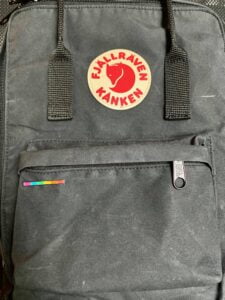
And I remember the feeling when I went into my village of actually taking it off my jacket and putting it away, putting it in a little bag and putting it in my suitcase, and I was kinda like ‘Yeah, I’m in a small village’, and I felt like I was putting a little piece of my identity away. I don’t know. It was a little sad. But it’s been years at this point, I know that when I go there, that’s how it is. And I try not to let it get under my skin too much, because I know it’s not my fault. It’s not my problem, it’s not that there’s something wrong with me, there’s something wrong with that kind of context.
It’s still a little sucky. Cause I’m kinda like ‘I just wanna wear my rainbow pin, f*ck it’, but it’s also ‘Eeh, do I wanna start a thing with parents and family… you know what, fine, you need me to be straight-ish for a week? I guess I’ll do it.’
Does it make me happy? It makes me sad for the people that can’t get out. Because I had the luxury or privilege to build a life where I wanted, some people don’t have that, and they have to stay there. So, you know, it does make me angry, it makes my blood boil for the people that cannot get out and have to live there. Because for me it’s a week every couple of months, I can do that, my real life is elsewhere, but for those that have to stay there? I don’t like it. At all.
The signs are positive, but it’s gonna take time and it makes me sad that some people will still have to suffer because of that. It’s an infuriatingly slow process, but I do see good signs, even in my own family. I have a side of my family that is very religious, and apparently they had known about my previous relationship, because I was in a seven-year relationship with another girl, and then when we broke up, my parents kind of told them that we had broken up and they had known that we were in a relationship, and they never treated me any differently.
It’s still not something that we talk about super openly, but I know that they know, and that has never changed their attitude towards me, and they’re very catholic, so… I don’t think ten years ago that would have been a possibility. At all. So, I remain hopeful.
L: That’s pretty intense.
Yeah. But, you know, it’s the same story when you come from very religious, very conservative backgrounds, we all have very similar experiences, coming from those types of environments. I was lucky, I wasn’t thrown out of the house or cut off or anything of that sort. I was just asked to keep it on the down-low, to, you know, not “parade it around” or whatever… which made me really feel like I want to parade it around, just for the f*ck of it. Sorry, I swear a lot.
But yeah, other than that… I’ve always been able to come home and have my parents’ love, so from that point of view, I was luckier than a lot of people, but it’s still restrictive. And I can also understand that, you know, my parents were scared of people’s reactions, very small, very small town, very catholic, very conservative…
