
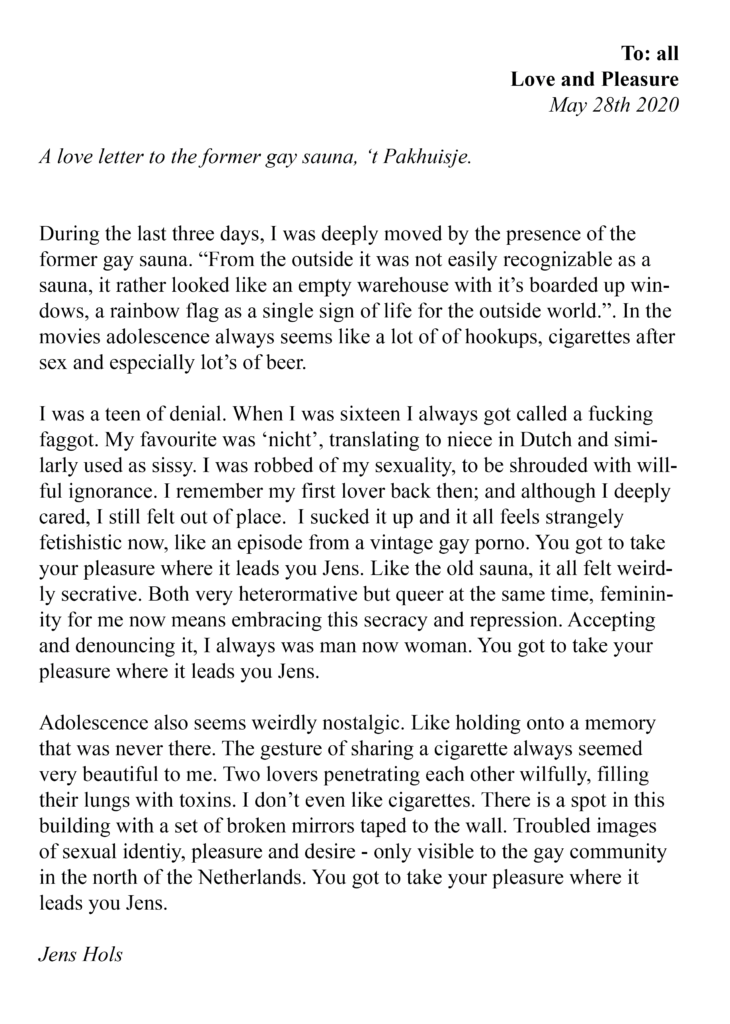
L: Before this interview, you told me about an artwork of yours, and I see a connection there to what you said earlier about how other people can influence how a space can feel for you. Do you want to talk about that a little bit?
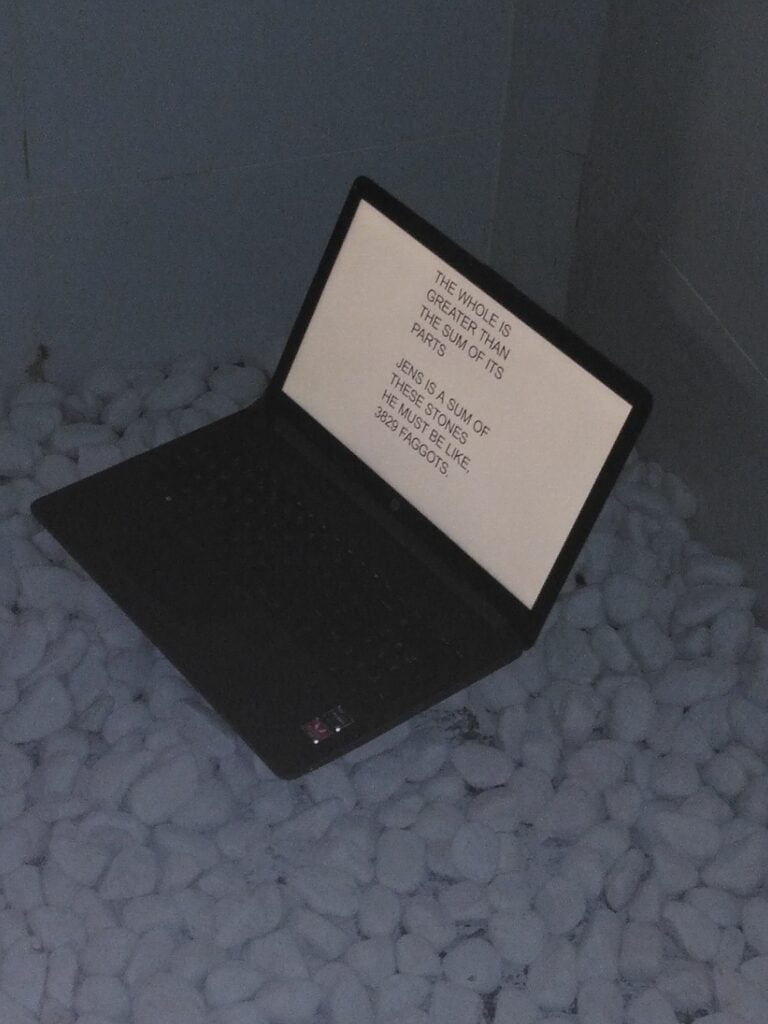
Yeah, I’m working on a sculpture, I call it an installation, but it’s also a sculpture and a performance, where there are two chairs in the room, and one chair has a laptop on it, saying in small letters on it ‘the artist is [not] present’.
“When am I ever more than a person, what even am I?”
For me, it functions on a level where I had a difficult family situation that made me question ‘When am I ever more than a person, what even am I?’ and then I got the assignment from school to present myself in a work of art, and I was like ‘This is very difficult’, because my identity and my expression of my identity is very fluid, so it was very aggressive in that sense that they wanted to enforce an identity onto me.
So, I was thinking, if I want to make this, let’s say collage, I answer but I also re-evaluate what it is that I am. The question I would ask is ‘When does the artwork manifest?’ and in the same moment ‘When does the artist manifest? When does the individual manifest?’
For me, when you enter a white cube, which is traditionally a space to present art, and you look at this very conceptual performance, it begs the question: “When is the artist appearing in the work of art, when is the individual appearing in it, when is the audience part of it?” Like, is the artist apparent, is the artist not apparent?
Also in correlation to Marina Abramović’s “The Artist Is Present” where she questions the role of when she is the art work and when not, but there is clearly an audience appearance. For me, the audience is a vital part of the work now, like the work of art is just a framing of the combination between experience and reflection, so all that is left after art, I think, that is the moment when we interact and that feeds art again, so, yeah, I present the question: ‘When does the work of art manifest?’, and the answer is: ‘The artist is not present’. But it’s also definitely very queer indeed, it’s very much about fluid identity, and enforcing identity is very much.. neoliberalist, if I would like to call it that, to make it pretentious [laughs].
L: Can you explain how so?
There’s this really interesting article about queer print making, where, when print making got popular, you had the artwork and the original reprint, and the art work would be male and the original reprint would be female, and it would be like a womb for all the other reprints, but the reprints are valued way less than the male artwork, so an institution is essentially asking ‘who are you as an artist?’ and the art markets always asks the same question ˗ by me saying ‘I cannot answer that’, I do a very Butlerian¹ gesture where I embrace the male and female aspects that are embedded within art and I queer them. Gender performativity in that sense. Because it still is a performance piece partly.
I like very theoretical arts, and it is socially engaged. I also think it’s very important to be aware of theories.
¹refers to judith butler (wikipedia link), one of the leading scholars in queer studies.
