
L: We talked about how people have crossed your boundaries, can you maybe also talk about what people can do to give you space when you feel you need it?
I think for me a big part of this is respecting when I cancel on plans, because I’m really working on that, on being able to say ‘No’ to plans and to overworking myself, and I don’t want to be under this pressure that I have to go to your house, or that I have to be there because it’s someone’s birthday, you know? So I feel respected in my autonomy, in my space, when I’m like ‘Sorry, I’m not gonna make it’ and that person is like ‘Ok, we can reschedule later, don’t worry’.
“I’m really working on being able to say ‘No’ to plans and to overworking myself.”
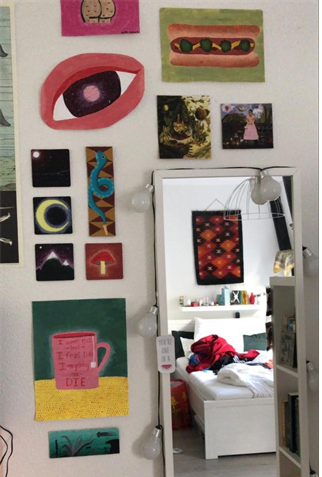
That’s important for me, especially right now, because I’m really starting to enjoy time alone, because I’m painting a lot as well, I’m decorating my house so that it feels like me… my house is my space also, and when I want to enjoy that on my own, I want someone to respect that, you know? Or when I’m sick, when my body, which is also my space, is not feeling ok, I wanna listen to that, I wanna honour that, and I wanna rest.
In this organization that I was in, that I already mentioned, I had it a couple of times that I said really clearly that I didn’t wanna go to an event, and the person would be like ‘I thought you were one of the most committed members, why are you not going?’ and all this guilt tripping. Don’t do that.
Because of how I related to my mother earlier, it’s so easy for me to feel guilty about things, I used to be really sensitive to guilt tripping – not anymore, I think, I can pinpoint this more easily, but it has been a process. If someone is in a position where they are sensitive to guilt tripping, you can really invade their space when you do this, because already it will be difficult for them to say ‘No’, and you’re disrespecting that by insisting.
So, I think that’s a really important way people can give me space, respecting when I say ‘No’. It’s also like consent, you know, and autonomy, they are really linked to anarchism. Just respecting people’s autonomy, and people’s rights to rule over their space and their bodies and their energy and their time.
L: I’m wondering, because you’ve talked about your anarchism: how do queerness and anarchism relate for you?
Oh, I love that one! I guess with anarchism a really big part is recognizing that everything has it’s own kind of importance, so for me how that relates to queerness is also realizing that for example trans bodies and cis bodies, there’s no such thing as the norm.
“Everything has it’s own kind of importance.”
I mean, we made a norm, and it rules over people, but we created it, there’s nothing naturally superior about anything, you know? It’s just different. The same thing with heterosexuality and with race and with all these things; I think that’s how they relate, I think just recognizing that all these unnecessary structures, like the gender binary, all these things are so limiting to people’s freedom.
There are so many possible futures, and it’s difficult to get there if you don’t think outside of the box.
For me, anarchism is about freedom and the ways I can find it, for example with body modifications, and also with being queer it’s about looking at these structures critically, like cisnormativity, heteronormativity, looking at them critically and thinking ‘Is this necessary? Is this helping us? Is it good for us?’ Because people created it, and we can also deconstruct it.
Obviously to the extent of our possibilities, but I think the main thing is just to think outside of the box, think creatively, and that’s also I think how anarchism and creativity relate, you know, going back to the very beginning of this conversation. There are so many possible futures, and it’s difficult to get there if you don’t think outside of the box.
